in Barcelona
· Spain ·
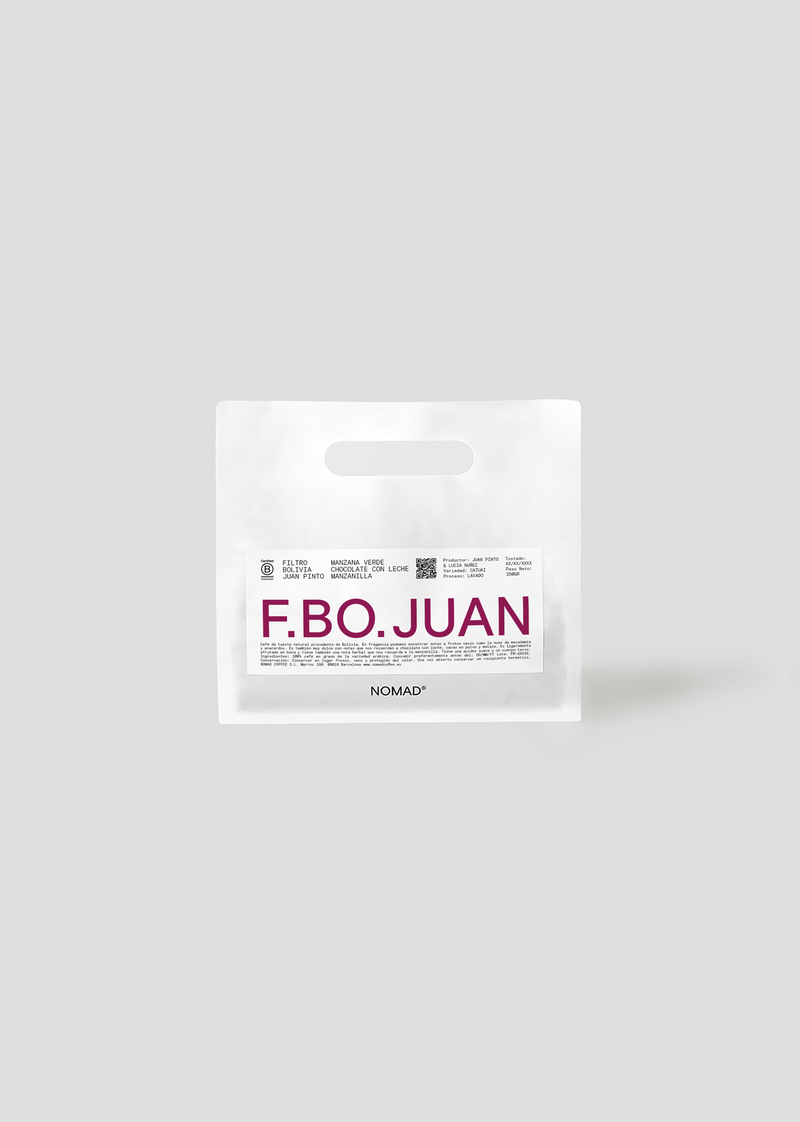
Bolivia Juan Pinto
Chocolate·floral·fruity
Sold out — back with the next roast. Nomad coffees land in small drops. Leave your email and we’ll let you know first.
Imported from Barcelona — we find these beans drink best 2–3 weeks after the roast date
Nutty, chocolatey and gently herbal — a washed Catuai from Finca Paraíso
Bolivia Juan Pinto is a washed single origin from Finca Paraíso in Bolivia, grown at 1,700 metres above sea level by Juan and Lucía. It is a Catuai lot from the 2025 harvest, roasted by Nomad in Barcelona. Nomad describe a cup led by nuts and milk chocolate, its acidity mild and its body smooth.
Tasting Notes
Green Apple · Milk Chocolate · Manzanilla
The aroma opens on nuts — macadamia and cashew. Sweetness runs deep — cocoa powder and molasses, with milk chocolate through the middle. There is a light fruitiness across the palate and a herbal edge that reads as chamomile. Acidity is mild, the body smooth.
Coffee Details
| Origin | Bolivia |
| Farm | Finca Paraíso |
| Producer | Juan Pinto & Lucía |
| Variety | Catuai |
| Processing | Washed |
| Altitude | 1,700 masl |
| Harvest | 2025 |
| Tasting Notes | Green Apple, Milk Chocolate, Manzanilla |
About This Coffee
This is a part of Bolivia better known for cacao than for coffee, which makes what Juan and Lucía are doing at Finca Paraíso worth paying attention to. The farm runs on an idea they call Vivir Bien — Living Well — inherited from the indigenous communities around them: the notion that you thrive alongside your neighbours and your land rather than at their expense. It shapes how they run the place as much as how they run a harvest.
Juan came to this from the ground up. His family grew coffee in Alto Beni, and he has over ten years at Agricafe behind him, working across wet processing, the lab, quality control, roasting and export. He never had formal training. What he knows came from watching, trying things and staying on the question of what could be done better — and it shows in the details: seedbeds laid out precisely, machinery kept spotless, storage looked after properly. Lucía works to the same standard on her own lot; she grows the Java, Juan the Catuai, and it has been a joint effort from the start.
The processing is patient work. Pickers take only fruit that has come to full ripeness, judged by a deep red colour. That fruit is pulped and sealed into plastic bags for a controlled ferment of 24 to 48 hours, which Juan tracks by hand and by experience. The coffee is then rinsed in fresh water and moved out onto raised beds, where a slow dry of 15 to 20 days brings it down to roughly 12% moisture.
How to Brew
| Method | V60 / pour over |
| Ratio | 1:16 |
| Coffee | 15g, medium-fine |
| Water | 240g |
| Water Temperature | 94°C |
| Total Brew Time | 2:45 |
Our house starting point — these numbers are ours, not Nomad's.
Start with a 45g bloom and give it 40 seconds, then pour in two or three even stages. If the cup tastes thin or sharp, grind a step finer or add a few degrees; if it turns dull and heavy, coarsen slightly and pour a little faster. Roast date, storage, your water and your kit all move the result around, so treat the numbers as a place to begin rather than a target.
How Much Coffee Is in a Bag?
A 250g bag gives you around 16 filter cups at a 15g dose, or about 14 double espressos at 18g — roughly two weeks of a daily morning brew, or a good weekend of sharing a pot with someone.
Frequently Asked Questions
Is it better for espresso or filter?
Nomad don't publish a roast level for this lot — they sell it ground for everything from espresso to V60. For what it's worth, our own read is that the nutty, chocolate-heavy sweetness and mild acidity make it an easy coffee to live with either way, so brew it however you normally brew.
What does it taste like?
Nomad list green apple, milk chocolate and manzanilla (chamomile). In their description the aroma is nutty — macadamia and cashew — and the sweetness is deep, running to cocoa powder, molasses and milk chocolate, with a slight fruitiness and a herbal chamomile note. Acidity is mild and the body smooth, so it lands clean and gentle rather than loud.
How fresh is the coffee?
Nomad roast in Barcelona and we ship on arrival, so it reaches Malaysia with some travel behind it. In our experience the beans are drinking at their best around 2–3 weeks past the roast date printed on the bag.
What does washed processing mean?
The fruit is stripped from the bean before drying — here by pulping the cherry, fermenting it for 24 to 48 hours, then rinsing it clean in fresh water. Removing the fruit early stops its sugars soaking into the seed, so what you taste is the bean and its origin rather than the fruit around it. Washed coffees tend to be the cleanest and most transparent in the cup.
New to single origin coffee and not sure where to start? Try the Taster Box to sample across our range. Brewing for a team? Take a look at our Office & Bulk Coffee. Free shipping within Peninsular Malaysia on orders over RM80 (RM150 for East Malaysia).
Brew it the Barcelona way
Filter / pour-over
- Ratio
- 60 – 70 g / L
- Grind
- Medium-fine
- Scale
- Weigh coffee & water
- Water
- 92 – 94 °C
Use a digital scale for both coffee and water. 60–70 g per litre depending on method, water and taste.